


Translate this page into:
Surgical Pearl: Disposable Syringe as Modified Customized Comedone Extractor
Address for correspondence: Dr. Muhammed Mukhtar, Mukhtar Skin Centre, Katihar Medical College Road, Katihar 854105, India. E-mail: drmmukhtar20@gmail.com
This is an open access journal, and articles are distributed under the terms of the Creative Commons Attribution-NonCommercial-ShareAlike 4.0 License, which allows others to remix, tweak, and build upon the work non-commercially, as long as appropriate credit is given and the new creations are licensed under the identical terms.
This article was originally published by Wolters Kluwer - Medknow and was migrated to Scientific Scholar after the change of Publisher.
Abstract
Abstract
The conventional comedone extractors available are not able to evacuate contents properly, because of their vertical pressure. So, the comedone extractor which can exert pressure simultaneously in vertical and oblique direction for complete evacuation is the need of the hour.
Keywords
Comedone
customized
disposable syringe
dragged
extraction punching

PROBLEM
Comedones are elongated or oval keratinous plugs that reside in the elongated pilosebaceous canals in seborrheic areas of body which are more commonly open at an angle of 20–30 degrees to perpendicular axis (rather than vertically).[1] Disposable syringe was used earlier vertically for extraction of contents of comedones from cysts.[2] For proper extraction of keratinous material of comedones, there is a need for an elongated or oval comedone extractor that should be pressed and dragged in an angulated manner instead of only pressing vertically over the lesion.[2] Therefore, we advise the use of a modified needle hub of a disposable syringe for better extraction of contents of acne comedones.
SOLUTION
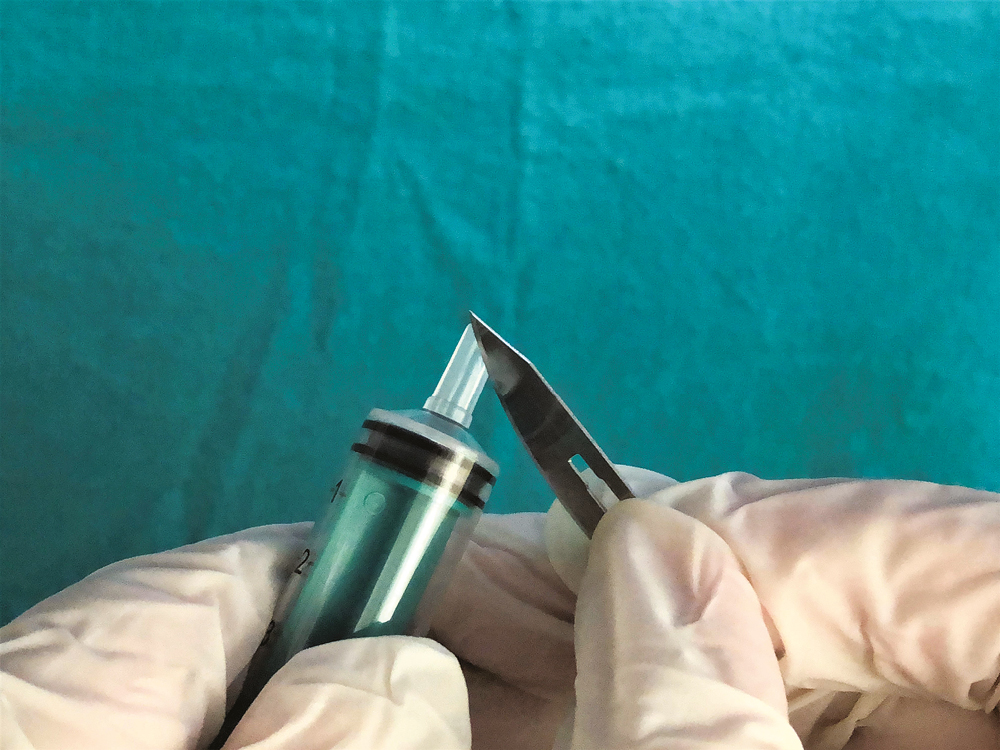
We took a disposable syringe (3 ml) and sliced its needle hub smoothly with a sterile surgical blade at an angle of 30–45 degrees (which can be less but not more than 45 to lessen the pressure trauma over the site) to make its punching end slightly inclined so that the surface of the punching end (i.e., rim) is oval to elongated in shape [Figure 1]. The comedones, papules, pustules (and small nodules) were opened/dilated under aseptic conditions with a hypodermic needle as standard procedure. Then the modified syringe is placed over the lesion, keeping its opening within the rim of the punching hub. With the syringe in place, the lesions are pressed with this syringe, and dragged [Figure 2 and Video 1]. There is no incidence of prick or puncture injury and post-inflammatory hyperpigmentation. During the procedure, bleeding is less and if it is there, it should be hemostasised as soon as possible to avoid post-procedure hyperpigmentation.

Declaration of patient consent
The authors certify that they have obtained all appropriate patient consent forms. In the form, the patient(s) has/have given his/her/their consent for his/her/their images and other clinical information to be reported in the journal. The patients understand that their names and initials will not be published and due efforts will be made to conceal their identity, but anonymity cannot be guaranteed.
Financial support and sponsorship
Nil.
Conflicts of interest
There are no conflicts of interest.
All videos available online
REFERENCES
- A tip for performing intralesional triamcinolone acetonide injections in acne patients. J Am Acad Dermatol. 2014;71:e127-8.
- [Google Scholar]
- Disposable syringe punching: An aseptic alternative to a comedo extractor. J Am Acad Dermatol. 2020;83: e175-6.
- [Google Scholar]